

The One Who Hears Before the Wind, Listener of the Desert
There are some women who do not arrive loudly.
They do not need to.
They enter like dusk, like memory, like a feeling you cannot quite explain but trust immediately. They are the women who know before knowing can be proven. The women who sense the shift before the room changes. The women who hear what is coming before the wind even begins to move.

Woman of the Quiet Knowing is one of those women.
She is not here to demand attention. She is here to hold it softly. To gather what is unspoken. To listen beneath the noise. To remind us that intuition has always been its own kind of wisdom.
There is something ancient in her presence. Something grounded, observant, and deeply attuned. She is not passive. She is not unsure. She is powerful in the quietest possible way.
She is the one who hears before the wind.
Between This World and the Next
What moves me most about her is that she feels rooted in two worlds at once.
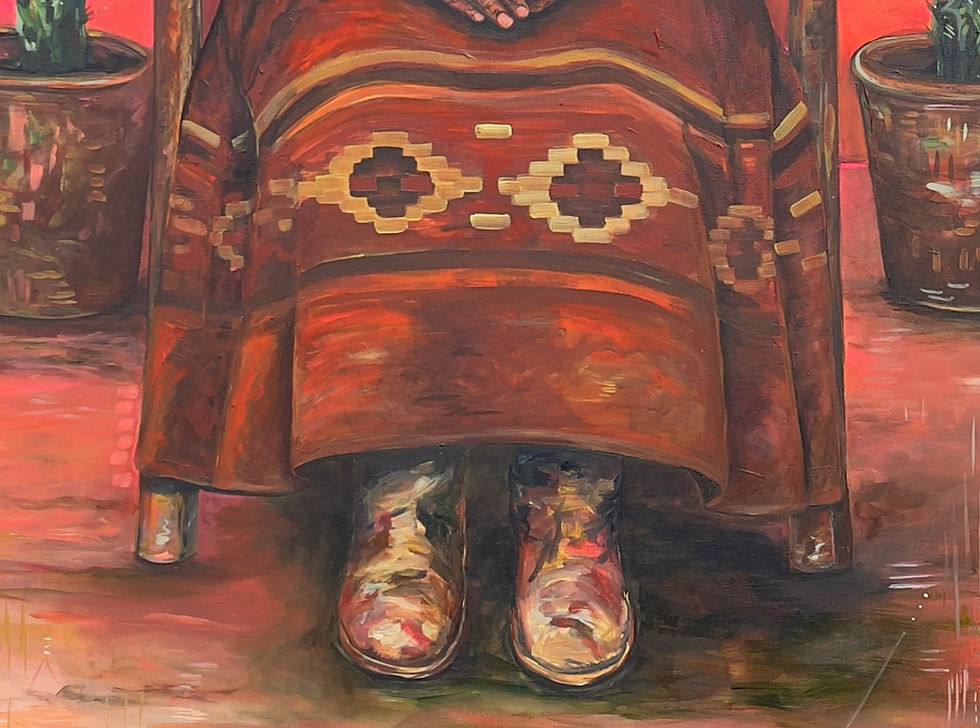
She belongs to this world—the world of body, weather, ritual, family, labor, heat, dust, and survival. You can feel it in the chair, the clay vessels, the cacti, the dress, the hat, the turquoise, the way her hands rest with such calm certainty in her lap. She is grounded in material life, in what is worn, carried, endured, and remembered.
But she also belongs to another world entirely—the world of intuition, spirit, ancestral memory, and unseen frequency. The world that cannot always be explained, only felt. The world that speaks through atmosphere, symbol, and sensation before it ever becomes language.
She is not split between those worlds. She is fluent in both.
That is what gives her such presence. She does not seem afraid of mystery. She seems in relationship with it. She sits at the threshold between what is visible and what is unseen, listening for what most of us move too quickly to hear.
Listener of the Desert
The desert has always felt like a place of revelation to me.
Not because it is loud, but because it is stripped bare.
In the desert, there is nowhere for excess to hide. What remains is essence. Bone. Sky. Heat. Spirit. The desert asks you to listen differently. It teaches you that silence is never truly silent. It hums. It watches. It remembers.
That is why Listener of the Desert feels so true for her.
She belongs to that kind of landscape—not only literally, but energetically. She carries its restraint, its endurance, its mystery. She feels shaped by a world where survival and spirit must live side by side. She understands that the land is never mute. That the body is never mute. That intuition is not fantasy. It is information.
She knows the difference between noise and truth.

The Cacti as Guardians
The cacti in this painting are not simply decorative. They feel like guardians. Witnesses. Sentinels.
They frame her almost like sacred pillars, reinforcing the sense that this is not merely a portrait, but a presence. Cactus energy has always felt to me like sacred resilience—a life form that knows how to survive harsh conditions without losing its essence. Something that stores what is needed. Protects what is tender. Blooms only when the time is right.
That matters here.
The cacti mirror the woman herself. She is not closed off. She is discerning. She is not hardened. She is protected. She has learned how to preserve what is sacred within her.
They stand beside her like witnesses to the life she has lived and the wisdom she has earned.
The Frequency Behind Her
The field behind her feels less like a background and more like an energetic atmosphere.
It glows. It hums. It vibrates.
The saturated pinks and oranges feel like heat, yes, but also like aura, memory, and spirit. The vertical drips and marks read almost like transmissions, as if another world is present behind her—or perhaps within her—and moving just beneath the surface.
This is what I think of as the painting’s unseen chamber: the place where intuition gathers before it becomes language. The place where memory, grief, spirit, and message live together.
And she sits in front of that frequency without fear.
She is not overwhelmed by the unseen. She is in relationship with it. The visible world may appear calm, but the unseen world is alive with presence. That contrast feels deeply human, and deeply feminine too—steady on the outside, cosmos on the inside.
Her Clothing and Sense of Time
Her clothing feels suspended between worlds as well—between history and myth, usefulness and ceremony.
It does not read to me as one exact historical costume, but rather as a blended, timeless desert matriarch silhouette. There are echoes of the late nineteenth into the early twentieth century, of frontier-era Southwestern portraiture, of garments shaped by weather, work, land, and identity. It carries the feeling of an older desert world where practicality, ritual, and presence lived side by side.
The wide-brimmed hat evokes the working landscapes of the American Southwest. It gives her the presence of a Western elder, someone made to endure sun, dust, and time. Her dress feels modest, grounded, and strong, carrying both domestic labor and sacred presence. The bands of color and geometric motifs feel less decorative than remembered—like lineage, memory, and story woven into cloth.
And then there is the turquoise.
Against the warmth of the painting, it feels like protection, truth, medicine, sky, and spirit all at once. The feather lifts the image beyond portraiture and into something more symbolic. She feels dressed not only by era, but by land, ancestry, and knowing.
She does not feel costumed. She feels lived in by history.
She is not dressed for fashion. She is dressed in belonging.

Annie and the Old One
As I sat with this painting, I kept thinking about Annie and the Old One BY: Miska Miles, a book I read when I was younger.
That story stayed with me because of the tenderness it held—the ache of loving someone so much you cannot bear the thought of losing them, the wish to stop time, the way grief and family and reverence become woven together. I do not see this painting as illustrating that story directly, but I do feel a thread between them.
This woman carries that same emotional depth. That same reverence for what is older than language. That same understanding that time is not something we can control, only move within.
There is grief in that. But there is also grace.
She feels like someone who understands that listening is part of loving. That witnessing another life—its seasons, its leaving, its becoming—is sacred work.
What She Stands For
She stands for intuition. For ancestral wisdom. For quiet strength. For discernment. For rooted femininity. For the women who feel everything and still keep going. For the women who sense the shift before anyone else names it. For the women who protect what is sacred and trust what they know.
She reminds me that not all power arrives with thunder.
Some power arrives in a whisper.
Some wisdom arrives before the wind.
And those quiet truths can change everything.

The Poem
By: MTR, 2026
Woman of the Quiet Knowing
They say she was old
before anyone counted years—old as mesa shadow,
old as river stone, old as fire remembering every hand that fed it.
She was born listening.
She heard the storm
before it gathered its skirts.
She knew which sorrowhad entered the house,
which door should stay closed,
which silence was speaking.
The old women said only:She hears what is coming.
So the land taught her.
The cactus taught herto keep tendernessbehind necessary thorns.
The clay taught her
what is shaped by hand
must survive the fire.
The desert taught herthat silence is not empty—it is where truth begins.
She dressed like the women
who belonged to weather and memory:
turquoise at her throat,dust at her hem,
a feather for wind,
a hat broad enough
to cast shade over sorrow.
Behind her, it was said,
there was always another room—not built by hand,
but made of ember,
spirit,
and the hush of the gone ones.
She was never afraid.
She knew the dead change only form:
into wind, into dream, into the sudden knowing
that tells you to turn home.
Women came to her quietly.Often, she did not answer.She only rested her handupon the tableas if to say:
Listen.It is already speaking.
And when her own time came,she met it as she met all things—still,open,listening.
Even now, they speak of her softly:
Woman of the Quiet Knowing.
The one who hears before the wind.
Listener of the desert.
And if you have ever feltthe air change before grief,before love,before rain—
you may know her.
Or perhaps
remember.
A Final Thought
At her core, Woman of the Quiet Knowing is about trusting what you feel before the world confirms it.
It is about honoring the undercurrent. Listening to the body. Paying attention to the subtle things. Remembering that silence carries intelligence too.
She asks what happens when a woman stops doubting her own knowing.
What happens when she honors the whisper?
What happens when she listens before the wind?
What happens when she finally trusts what has been speaking inside her all along?
Maybe she becomes more fully herself.
Maybe she remembers she always was.
She is a keeper of subtle truths. A witness to both worlds. A woman shaped by land, by memory, by endurance, and by spirit.
And perhaps that is why she feels so familiar.
We know her.
Somewhere deep down, we have always known her.
With love and light, and most importantly, with joy,
XOXO, Missy


Comments