

The Woman in White, Rewritten in Red Soil

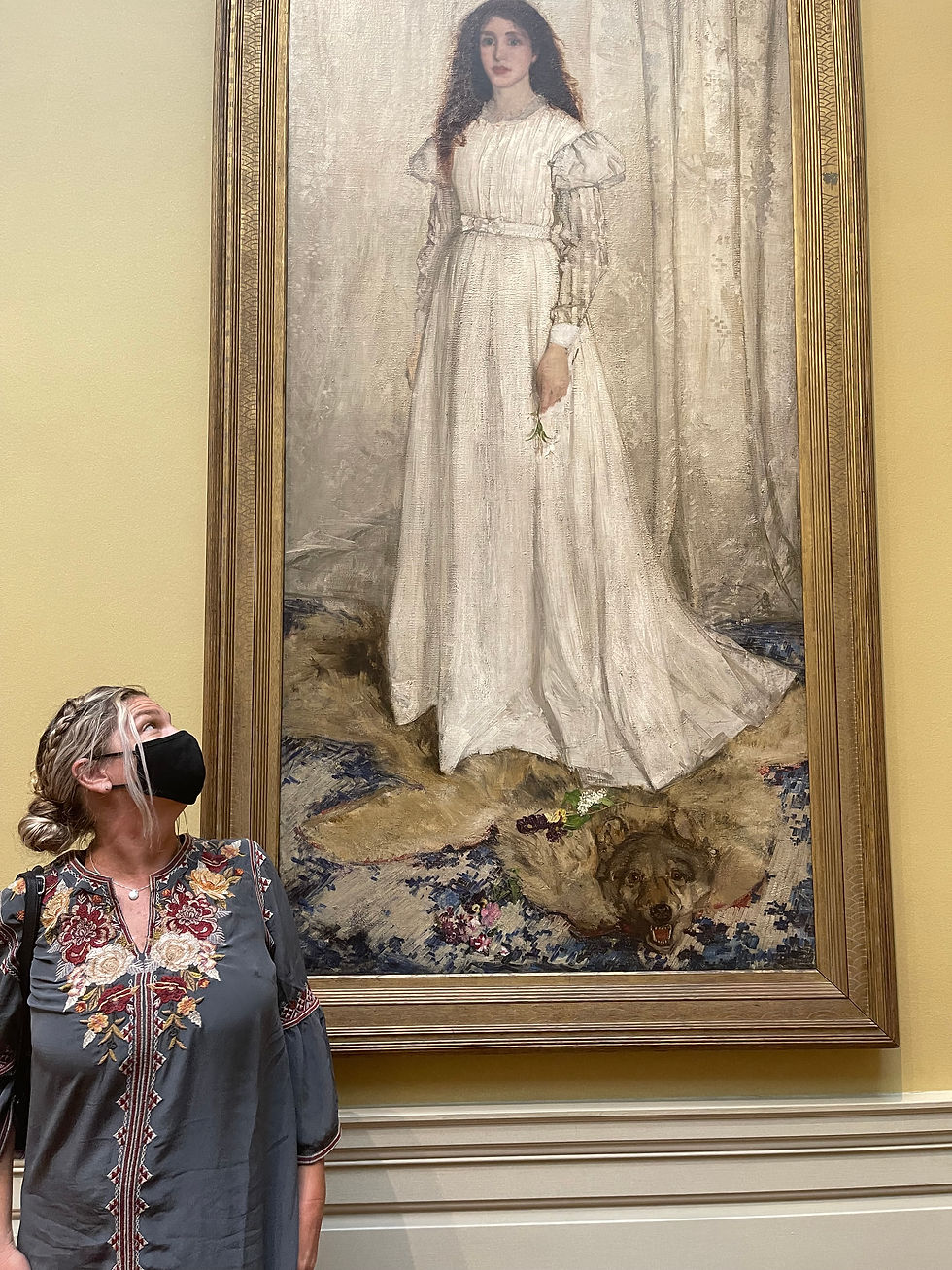
There was another painting quietly sitting in the back of my mind when this one came through: James McNeill Whistler’s Symphony in White, No. 1—The White Girl.
A woman in white. A painting that has been studied, projected onto, and interpreted again and again. Some have described it as a symbol of lost innocence. And even though Whistler was known for “art for art’s sake,” for the idea that art did not need to explain itself or carry a fixed narrative, people still wanted to know what it meant.

That is what we do, isn’t it?
We stand before a woman in a painting and ask her to explain herself. We stand before beauty, mystery, and silence and ask it to speak.
I have always been the opposite in my work.
My paintings do mean something.
I am telling a story with each piece.
Not always a literal story. Not something neatly packaged or fully explainable. But there is always a pulse beneath the paint. A current. A reason she arrived. These feminine energies come to me, and I give them form. I listen, and then I paint.
So while Symphony in Spirit, No. 1 was inspired in part by the idea of the woman in white, she is not a repetition of that story.
She is a rewriting of it.
She does not stand for loss.
She stands for remembrance.
Not Innocence Lost, But Presence Found
Some critics have spoken of the woman in white as a symbol of innocence lost. That idea stayed with me, but not because I wanted to echo it. I wanted to turn it.
I wanted to ask something else.
What if the woman in white is not fragile?What if she is not fading?What if she is not a symbol of something taken from her?
What if she is fully here?
This woman does not feel lost to me. She does not feel passive. She does not feel like a ghost of softness.
She feels rooted.
She feels awake.
She feels deeply connected to the land beneath her.
She stands not as a loss of innocence, but as one who is fierce in her belonging. She is grounded, embodied, and claimed by the earth—and in return, she claims it too.
She is not drifting above life.
She is in it.

The Story the Color Red Tells
The red in this painting is not background.
It is not simply atmosphere, sky, or setting.
It is story.
It is root.It is survival.It is blood memory.It is heat.It is ancestry.It is belonging.
Red is the color of the root chakra—Muladhara—the first energy center, the place of grounding, stability, safety, and survival. It is connected to the body, to the earth, to our basic needs, and to the deep human need to feel anchored here.
Red says:
Stay.Be here.Stand in this life.Trust the ground beneath you.
That frequency lives throughout this painting.
To me, spirituality is not about leaving the body or floating above the hard parts of being human. It is not about escape. It is about arrival. It is about coming fully into yourself. Into your body. Into your truth. Into the land beneath your feet.
The red around her reminds us that before we rise, we root.
Married to the Land
There is something ancient in her.
Not old in age, but old in knowing.
She feels like the part of us that remembers we belong not only to ourselves, but to the earth. To rhythm. To inheritance. To something older and steadier than the moment we are living in.
She feels married to the land.
Not posed upon it.Not decorating it.Not visiting it.
Married to it.
The red around her feels like more than place. It feels like bloodline. Like memory. Like Mother Earth herself.
She is not separate from the landscape.
She is in relationship with it.
The land is not just where she stands. It is what formed her, what holds her, what remembers her—and what she remembers in return.
She feels like a reminder that to be spiritual, we must first be fully human. Fully grounded. Fully connected to the soil beneath our feet.
The Body as Ceremony
She is holding flowers. She is wearing flowers. She is marked with symbols.
She feels ceremonial.
Not in a performative way. In a sacred way.
There is something bridal in her, yes—but not in the traditional sense. She does not feel like she is waiting to be chosen. She feels already devoted. Already in vow. Already in relationship with something deeper.
Not with another person.
With truth.With earth.With presence.With her own becoming.
The bouquet in her hand is one of the details I love most because it brings tenderness into a painting that feels larger than life. It reminds me that she is not only mythic—she is intimate too.
She is monumental and soft. Protective and blooming.
She is both altar and offering.

A Crown of Wild Frequency
The floral crown lifts her beyond portraiture.
It expands her upward and outward, giving her a presence that feels more like spirit guide than simply woman in a dress. It gives her radiance. Scale. A kind of energetic halo.
Flowers often symbolize beauty, softness, blooming, and impermanence. But here, they feel like more than adornment.
They feel like recognition.
As if the field itself crowned her. As if nature placed its blessing on her head.
And because the crown is loose, wild, and full of motion, it reads less like decoration and more like aura.
Not a tidy flower crown.
A frequency crown.
It feels like intuition, signal, spirit, and transmission.
There is something especially beautiful in the contrast between the flowers and the desert. Flowers are fleeting. Desert endures. One blooms briefly. One remains. Together they hold tenderness and resilience in the same breath.
That is her too.
The Markings She Carries
The markings on her face and body move her beyond portraiture and into symbol.
They feel ceremonial, protective, and intentional.
They suggest that she belongs to something deeper. That she carries lineage, identity, resilience, and memory. That she has crossed through something and returned marked by it—not with damage, but with meaning.
I love how the markings frame her gaze without making her louder. She remains calm. Still. But the symbols keep her from being read too quickly. They interrupt easy beauty. They ask the viewer to stay longer.
To look beyond the dress and flowers and ask what she carries.
To me, these markings speak of courage, transformation, protection, and spiritual connection. They hold the same energy I return to again and again in the Spirit Guides—strength, symbolism, remembrance, and truth.
She feels like someone who has lived.
Someone who knows.
Someone who has come through fire and returned with symbols instead of explanations.
\

The Turquoise Ring
The turquoise ring matters.
It may be a smaller detail in the overall painting, but it acts like a visual anchor.
Against the white and red, it flashes with its own kind of medicine.
Turquoise has long been associated with protection, healing, truth, sky, water, and spirit. Here, it feels like a bridge between earth and intuition. A cooling, ancient force in the midst of all the heat.
And because it rests on her hand, it feels tied to action.
To what she touches.To what she carries.To what she blesses.To what she offers.
It reminds me that her power is not only symbolic.
It is embodied.
The Mesa as Witness
The mesa behind her feels like witness.
Steady where she is intricate.Ancient where she is living.Massive where she is detailed.
It gives her a counterpart—an elder presence in the painting. Something that has endured time, weather, silence, and change. Something that knows how to remain.
This is part of what makes the painting feel so rooted. The landscape is not decorative. It is a participant.
It tells us where she belongs.
It tells us something about what shaped her.
When I began bringing landscape into these Spirit Guide paintings, that shift mattered. I wanted to know not only who they were, but where they lived. What they saw. What held them. What they were bringing into the world.
The mesa helps give coordinates to her energy.
She does not stand in symbolic nowhere.
She stands in a world.

The Language of Cycles
The celestial orbs beside her feel like more than sun or moon.
They feel like phases. Portals. Echoes of time.
They speak the language of cycles—of becoming, returning, waxing, waning, remembering. They carry a deeply feminine rhythm, not in a surface way, but in a spiritual one.
Not all growth is linear.
Not all transformation moves in a straight line.
Some of it comes in spirals. In repetition. In seasons. In return.
These circles make the painting feel as though it is holding more than one moment at once: past, present, future. Earth and spirit. Ancestor and self. The seen and the unseen.
That is part of why she feels mythic.
This is not simply a woman in a landscape.
This is a state of being.
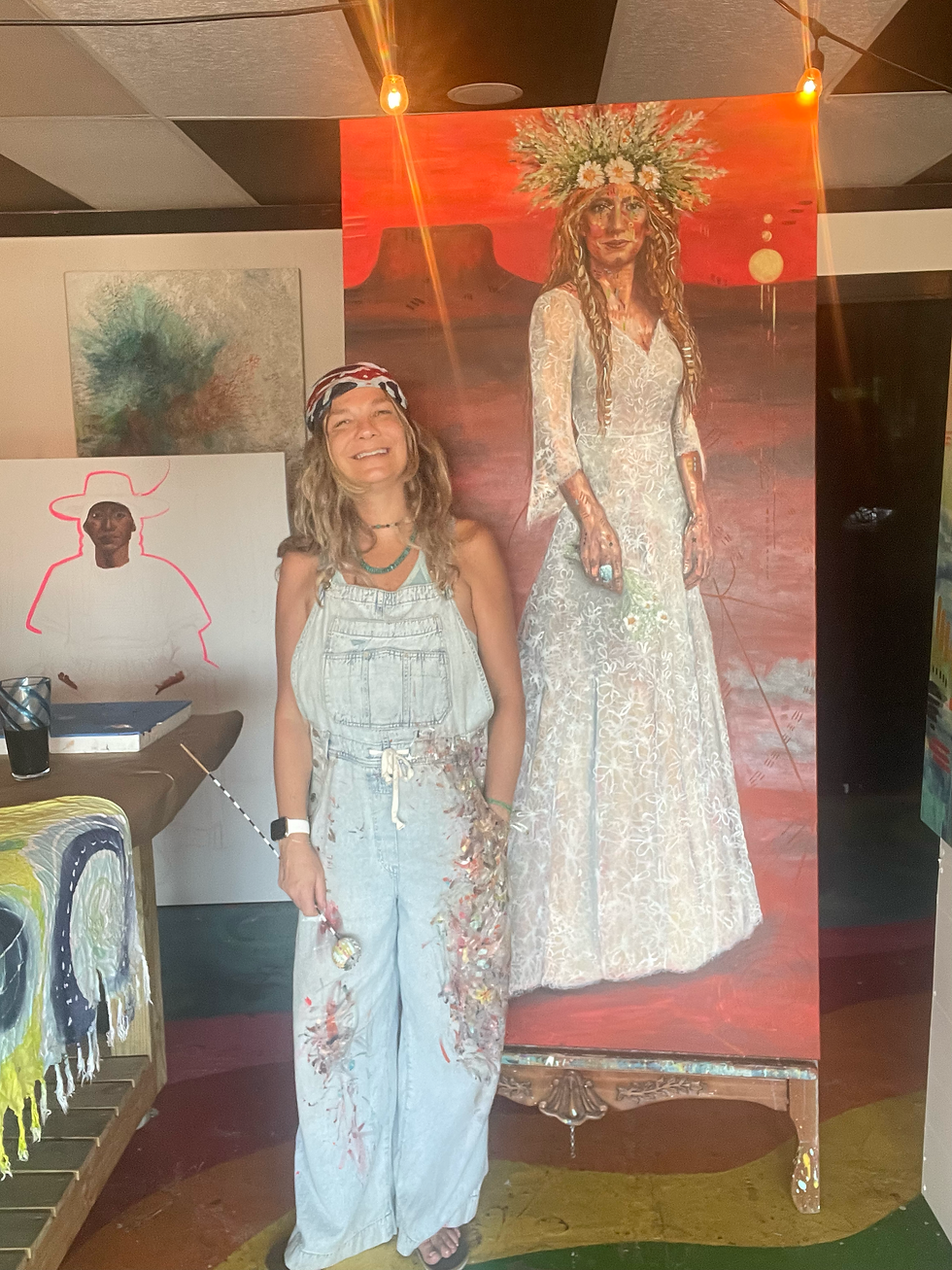
Is She a Self-Portrait?
I have been asked that, and the truest answer is: not intentionally.
I did not set out to paint myself.
But paintings often tell truths we do not consciously plan for.
She was painted during a time when I was reconnecting deeply to myself—to my body, to my instincts, to what felt grounded and real, to what had been buried, to what was mine.
So perhaps some part of me lives in her.
But she is not me alone.
That is important.
She is us.
She is the part in all of us that longs to return to ourselves. The part that longs to feel rooted instead of scattered, embodied instead of untethered, grounded instead of performed.
She is not me.
But perhaps she came through me during a time I needed her too.
The First Guide in Her Environment
This painting marked a shift for me.
She was the first Spirit Guide I painted fully in her environment.
That was the beginning of something.
Before this, the guides arrived strongly on their own. But with her, the landscape entered the story in a new way. The atmosphere mattered. The setting mattered. The world around her became part of the message.
I wanted to know more.
Where does she live?What does she see?What holds her?What is she bringing into the world?
As each guide is painted, their companions are created too. Their symbols appear. Their relationships unfold. Their stories begin speaking to one another.
They are not isolated to me.
They are connected.
That is why this title matters so much:
Symphony in Spirit.
Not one note.Not one voice.Not one message.
A chorus.
And she was the first guide to step fully into her landscape.

She Does Not Apologize for Her Scale
With all of these paintings, I want them to feel larger than life.
Not only in size, though scale matters to me. I want them to take up space energetically. I want them to hold the wall the way truth holds a room.
I want them to exist without apology.
That feels part of the message too.
So many women have been taught to shrink. To soften themselves into something easier, more acceptable, less intense, less visible. I am not interested in that.
I want these guides to stand fully in their magnitude.
She does not need to shout.
She does not need to perform.
Her stillness is enough.
Her body language is quiet, but it is not small. Her hands are relaxed. Her shoulders are open. Her gaze is steady.
She is simply there.
And that presence becomes authority.

Where Spirit Meets Soil
More than anything, this painting feels like a union.
White and red.Softness and endurance.Flower and desert.Adornment and survival.Human and archetype.Spirit and soil.
That may be the deepest symbolism of all.
She is not divided between being earthly and being spiritual.
She is both.
She reminds us that the sacred is not somewhere far away. Not somewhere above us. Not somewhere we only touch when we leave our humanity behind.
The sacred is here.
In the body.In the land.In ancestry.In survival.In tenderness.In flowers.In dust.In the hand that carries.In the symbols worn on the skin.In the stillness of someone who finally remembers who she is.
She is not innocence undone.
She is spirit embodied.
She is what happens when a woman remembers she belongs—not to performance, not to expectation, not to whatever story is projected onto her—but to herself, to the earth, to something ancient and unwavering beneath her feet.
She does not stand apart from the land.
She is in covenant with it.

The First Note in a Larger Song
She is one painting, yes.
But she is also a threshold.
A first note in something larger. The first guide placed fully in her world. The first time landscape became not just backdrop, but language. The first time the land became witness, participant, and companion.
She opened a door.
And once she did, the others began arriving with even greater clarity—their companions, their symbols, their environments, their messages, their stories.
This is how they come to me.
These feminine presences. These energies. These messengers.
I do not invent them so much as listen for them.
Then I paint.
And what emerges is never only about me.
It is about us.
Our bodies.Our memories.Our belonging.Our longing to root more deeply into what is real.
Symphony in Spirit, No. 1 is the woman in white rewritten—not as loss, but as return.
Return to the earth.Return to the body.Return to instinct.Return to belonging.Return to the fierce and quiet power of standing fully where you are.
She is red soil in human form.She is memory in lace.She is ceremony and witness and bloom and endurance.
And she stands there, still and certain, as the first note in a symphony that is still unfolding.
The Poem
When the Earth Remembers You
-MTR 2026
There are days
I forget
I belong to something ancient.
Not the calendar,
not the noise,
not the small hungers
of wanting to be seen—
but to the fields below language,
to the red dirt,
to the grandmother silence
still living under my ribs.
And then something happens.
A wind through dry grass.
The smell of rain on dust.
A bird lifting suddenly
from the fence line.
And I remember
I was never separate.
The body knows this
before the mind does.
The body knows
how to kneel near the garden,
how to place a hand on stone,
how to stand still enough
to hear the old ones
moving through the roots.
Not as ghosts.
Not as shadows.
As presence.
As a hum in the blood.
As the feeling that some part of you
has walked this land before,even if your feet
have only just arrived.
What is ancestry
if not a long remembering?
What is prayer
if not returning
again and again
to the ground beneath you?
I think the earth
is always calling us back.
Not loudly.
Not with punishment.
But with the patient voice
of something that has seen
every season of us—
our running,our grief,
our forgetting,
our little costumes of certainty—
and still says,
Come here.
Sit down.
Put your hands in the dirt.
You do not have to be anyone else.
You only have to listen.
There is a red thread
that runs through all living things.
Through branch and bone,
through river stone,
through the women
who carried songs in their mouths
and sorrow in their backsand still bent down
to gather what was needed.
I think of them often—the unnamed,
the unpraised,
the ones who knew
how to make life from very little,
who spoke to herbs,
who watched the moon,
who buried their grief
and kept loving anyway.
Their knowing
did not leave.
It is here
in the way some of us ache
for open land,for firelight,
for a silence deep enough
to hear ourselves again.
Maybe grounding
is not something we learn.
Maybe it is somethingwe remember.
Maybe the soul
is like a root system—quiet,
hidden,
always reaching
for what will hold it.
And maybe healingis not ascending at all.
Maybe it is bending low.
Touching earth.
Calling your spirit back
from all the place
sit scattered itself.
I do not want
a life above it all.
I want the kind of life
that can still feel
the pulse in the ground.
I want to know
the names of trees.
The moods of the sky.
The holiness of ordinary things.
I want to belongto this worldthe way wildflowers do—
not by earning it,
not by proving it,
but by growing
where the ancestors
once whispered,
yes.
here.
this is the place.
May she remind you to come back to yourself.
To the body.
To the earth.
To the quiet wisdom that lives beneath all the noise.
May she remind you that grounding is not heaviness, but belonging.
That ancestry is not only something behind us,
but something still moving through us.
That there is strength in softness,
power in stillness,
and something holy in remembering where you come from.
This painting was the beginning of a larger unfolding for me—one of the first
moments a guide stepped fully into her landscape and showed me not only who she was,
but where she belonged.
And in doing so,
she reminded me that perhaps
we are all looking for the same thing: a way back to what feels true, rooted, and alive.
Thank you for being here with me, for reading, for witnessing, and for allowing these guides to speak to you in their own way.
With love and light,
and most importantly, with joy,
XOXO, Missy


Comments